Panama – Live for More

31. März 2026 joerg
 Intro
Intro
„Just getting away, catching a breath, and forgetting all the crap going on in the world. At that point, it didn’t even matter how we ended up choosing Panama, especially since it wasn’t even on our bucket list.
But while it’s cold and dark back home—where you have to bundle up in winter gear, pop Vitamin D daily just to stave off bone decay and depression, and spend a huge chunk of your paycheck on heating—Panama has perfect weather. And that’s 365 days a year! Flip-flops, board shorts, a T-shirt, and sunglasses, and you’re all set for a day in paradise.
The deeper you dive into a destination, the more cool stuff you find. Rainforests crawling with tapirs, monkeys, sloths, crocodiles, and jaguars. Gorgeous coastlines on both sides of the country where, depending on the season, you can spot humpback whales, dolphins, sea turtles, hammerheads, manta rays, and whale sharks. Then there are the indigenous tribes like the Ngäbe, Buglé, Guna, Emberá, Wounaan, Bribri, and Naso Tjër Di, many of whom still live by their traditions. In total contrast, you’ve got the modern vibes of Panama City and the Panama Canal. You could stay for three months and never get bored.
It’s a mistake to think you can really get to know a country in just two weeks. You’ve basically just visited and looked at a few things.
Since our trip to Panama was so last-minute, we had to put everything together ourselves. Initially, we looked into booking tours and taking buses or shuttles to Santa Catalina and Bocas del Toro, then flying back to Panama City. But the shuttles to Santa Catalina, Bocas, and the San Blas Islands, plus the return flight, would’ve cost over $1,000. For just two people, that doesn’t add up. A mid-size 4WD rental—which you need to get to the San Blas Islands—costs about $630 (€581). With a price difference like that, it doesn’t even matter if the car sits unused at the harbor baking in the sun for a couple of days.“
Anreise
„Condor offers flights from Berlin to Panama City for €700 per person. The catch? An eight-hour layover in Frankfurt. That’s too long to just sit around at the gate, but too short to check into a hotel and get some real sleep. If you want decent connection times, you have to shell out an extra €290. So, we’re flying Air France from BER via CDG to PTY for €970 per person.“
Paseo Esteban Huertas
Panama City
You can research everything online these days—look at photos, watch videos, follow bloggers and vloggers, and imagine you’ve got a perfect handle on a place. But our first day in Panama City was a reality check, proving once again that being there in person is always different from what you imagined. Our first stop, the Mirador Flamenco, was blocked off by construction fences and gates. It was probably just too early. On the way back, we passed Frank Gehry’s Biomuseo, which looks like a giant, messy heap of colorful shapes. After that, we wandered through Casco Viejo. We rolled in just after 8:00 AM, which turned out to be a stroke of luck.
The streets were still peacefully quiet, aside from the drone of generators and power washers. The restored Iglesia de San José is definitely worth a look—it houses the famous Altar de Oro (Golden Altar), a Baroque masterpiece made of mahogany and covered in gold leaf.
The story of the Arco Chato in the ruins of the Iglesia de la Compañía de Jesús is pretty wild. After surviving 333 years, two fires, and an earthquake, it finally succumbed to government neglect in 2003 and collapsed along with other parts of the building. Today, visitors are just looking at a replica.
Strolling further through the streets of Casco Viejo, we reached the Catedral Basílica Metropolitana Santa María La Antigua at Plaza de la Independencia. This cathedral is a huge draw if you’re into old architecture or churches.
In Casco Viejo, a group of artists, café owners, and shopkeepers have teamed up to revitalize the neighborhood. They sell exclusively locally-made goods, and you can only hope that more tourists like us do their „tourist duty“ and support these efforts by spending some cash.
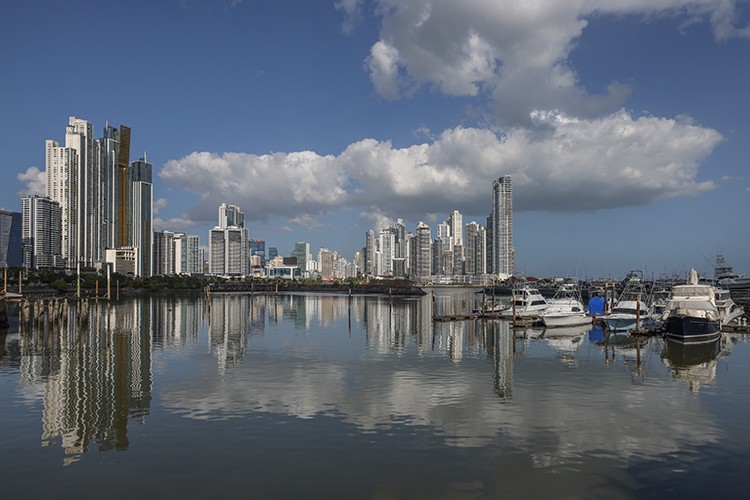
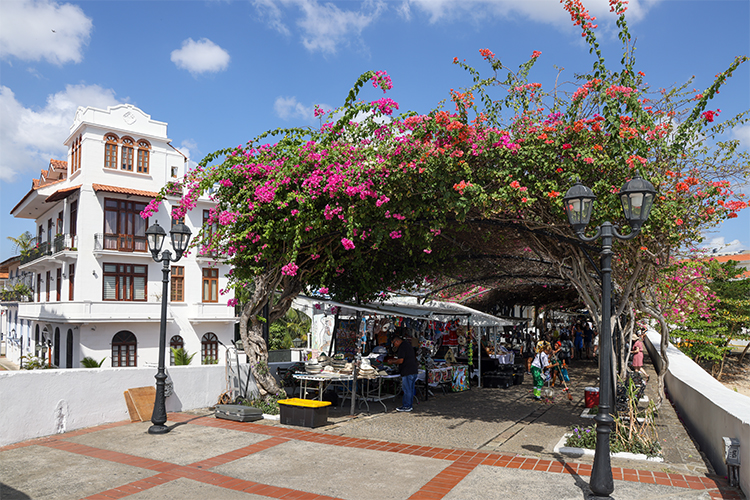
The Paseo Esteban Huertas at the eastern tip of the peninsula is also quite nice. It’s a bougainvillea-covered promenade built right on top of the old city walls. From here, you get a panoramic view of the modern Panama City skyline, the bay, and the ships. During our walk, several tour buses from the cruise ships in Colón dumped their „human cargo“ into the streets. Suddenly, large groups of people on „supervised tours“ were everywhere, clogging the sidewalks. Bumper-to-bumper traffic crawled through the narrow alleys. The roar of engines mixed with construction noise, babbling crowds, and exhaust fumes. Time to get out of the old town.
We headed to the Bridge of the Americas, which connects North and South America. To our disappointment, we missed a massive container ship passing under the bridge by just ten minutes. Just like before, I couldn’t get my drone in the air because of a no-fly zone, so all I could do was snap a quick „I was here“ photo.
Next stop: Ancon Hill. On Google Maps, it looked like you could drive pretty close, but nope! The parking lots and streets were packed, and once we finally found a spot, we had to hike two miles uphill in 93°F (34°C) heat. Pro tip: don’t be an idiot like us and forget to bring water. The view from the top is pretty unspectacular since it’s almost entirely overgrown with trees, but I already knew that. In this case, the research was right—the hike itself was the only real challenge.
The afternoon rush hour was brutal on the way back to the hotel, and it got even more apocalyptic as we headed to Mirador del Pacifico. The traffic alone is enough to make you never want to live in Panama City. Honestly, the city hadn’t really „clicked“ for us yet. But as the sun touched the horizon that evening, the heavy humidity gave way to a gentle breeze. Joggers ran to the city’s pulse. At twilight, the waterfront promenade transformed into an open-air gym, a marketplace, and a hangout for night owls. In the background, palms swayed in the light wind, and the glowing facades of skyscrapers reflected in the bay. In that moment, you finally feel the magic of Panama City and wish you could bottle up the atmosphere.
Panamanian white-faced capuchin
Tourist Crap with GetYourGuide
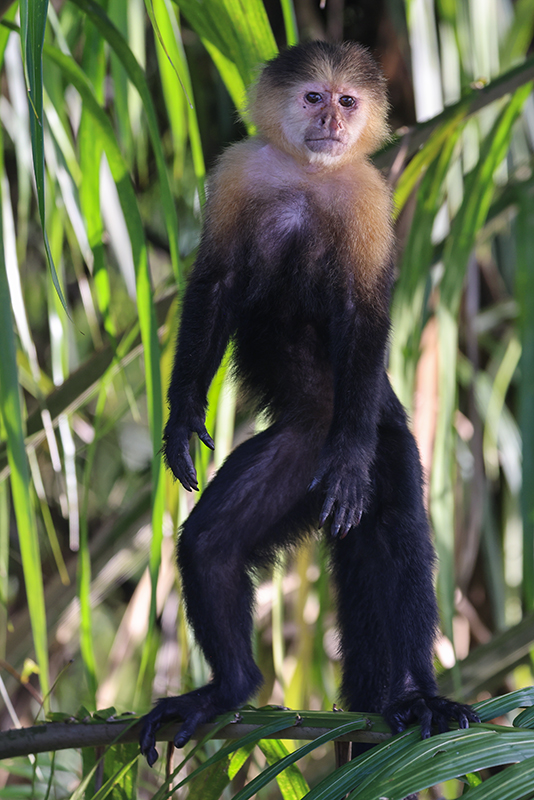
Today, for our anniversary, we’re doing something totally wild: we booked the cheapest tour on GetYourGuide! It’s a trip through part of the Panama Canal to Gatun Lake to gawk at monkeys and bother some sloths. We got picked up right before our fancy free breakfast buffet. There were only nine of us, and two of them actually sat right next to us on the flight here. You just can’t escape people, not even in the jungle.
After an hour’s drive to the boat dock, there was the first reality check. Up until yesterday, the thought was, “Wow, it’s so much cleaner here than the rest of Central or South America,” but this place proved otherwise. Trash was everywhere, floating in heaps along the shoreline. The boat zipped past massive cargo ships while bouncing over the waves. On the bank, a Panama Canal Railway freight train pulled its load through the soft morning light.
Then, Gatun Lake. There were sightings of monkeys that climbed right onto the boat and two sloths tucked away in the crooks of branches for a nap. Sloths sleep about 18 hours a day and only climb down to the ground to use the bathroom. If sloths were truly lazy, they’d just use gravity and handle their business right from the branch. But hey, what do tourists know about rainforest etiquette?
After two hours, the tour was already over, and there was a visit to a local outdoor restaurant. The final stop was Soberanía National Park. The group trudged through the jungle for an hour on mostly well-maintained paths without seeing a single forest inhabitant. On top of that, almost half an hour was wasted at a tiny, unphotogenic waterfall. That’s just the price of these tourist tours—being forced to do stuff that’s a total waste of time. Still, for about $43 (€40) per person including the park entry fee, it was actually a pretty good deal. A cheaper way to get a solid lesson on the pointlessness of mass tourism is hard to find!
Back in Panama City, there was a visit to the Cleo Cat Café & Shop (Calle Manuel de Jesus Quijano 169099-19). For anyone wanting to escape the deafening noise of Panama City for a moment and who likes cats, this place is a must-visit at least once.
San Blas Paradise
I first discovered the San Blas Islands in a documentary years ago and made a mental note to visit if we ever ended up in Panama. Back then, they were described as a nearly untouched Caribbean paradise—and maybe they were. But even today, thousands of bloggers and vloggers still hype San Blas as a „hidden paradise,“ no matter how many people are visible in the background. While the Guna people, who live autonomously in the „Comarca Guna Yala,“ try to limit tourism, they’re only human—and like everyone else, they’ll follow the call of money. There are 711,000 posts on Instagram with the hashtag #sanblasislands, and once something hits Insta, you can kiss the idyll goodbye. The newly paved road only makes it easier for the masses to reach this „dream destination.“
We haven’t driven a road this intense in a long time. The engine of our underpowered Suzuki Grand Vitara Hybrid was screaming, barely making it up the steep San Blas Hills. The road winds through the forest in tight curves, only to plunge straight down again after the next bend—a pattern that repeats for 25 miles. It’s the kind of drive that practically guarantees a „puke stop.“ At the Guna checkpoint, it feels like an international border; Guna militia inspect the vehicles thoroughly and flip through passports. Three guys even check if the cars are actually 4WD, which is a bit absurd since the road was recently upgraded and paved. After paying the $50 fee ($20 per person plus $10 for the car), we’re allowed to continue.
We reached the port of Cartí at 7:30 AM. Shortly after, the harbor filled with hundreds of day-trippers and people staying longer on the islands or boats. Tour guides and boat captains scurried around looking for their passengers, checking passports, and collecting cash. The gears of the tourism machine in Guna Yala only turn with enough grease. The harbor looks like a construction site, suggesting they have big plans for the place. Our boat finally pushed off at 9:00 AM—we were lucky we got up so early, or we might have missed it!
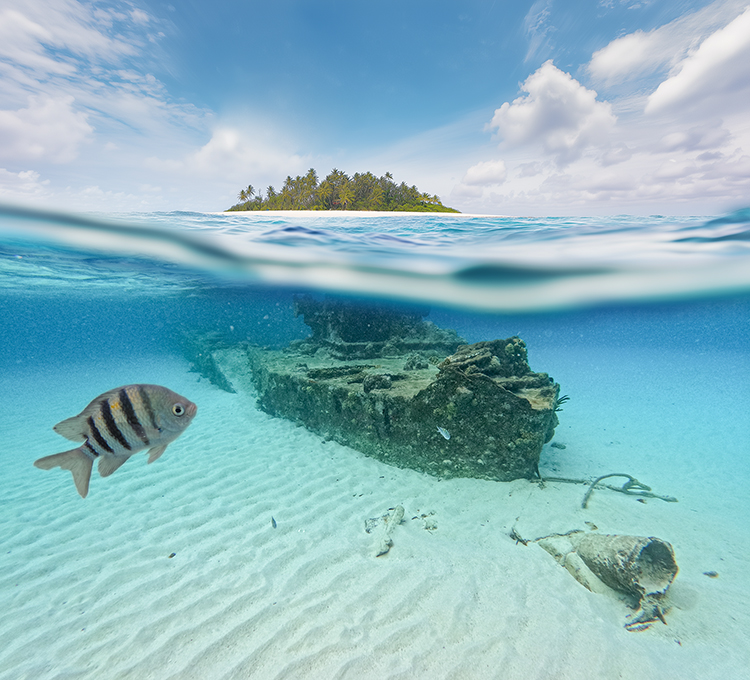
The Colombian freighter „Buenaventura,“ which ran aground near Isla Perro in 1958 after a calculation error and poor visibility caused it to hit several reefs in the night.
The boat fought through rough seas for 50 minutes until we reached the catamaran that would be our home for the next few days. Since we had some time and drones aren’t allowed, we visited nearby Chichime Island. If you stay overnight here, you’d better bring a very long book—or a rope to hang yourself. It was surely a paradise once, but then the tourists came and brought their trash with them. That changed everything for the Guna and their island sanctuary. Looking closely, Chichime is basically a landfill with guest accommodations. Trash is everywhere—on the beach, in the bushes. Every now and then, some of it gets burned, but plenty still ends up in the ocean; you can see it sitting on the seafloor while snorkeling. It’s a similar story on the other heavily visited islands. Since San Blas is governed autonomously by the indigenous Guna, there’s almost no oversight. They might clean the beach in the evening, but the motivation to truly protect nature seems pretty low.
Our catamaran moved from Chichime to Isla Perro Chico today, so we only saw the islands swamped with day guests. We waited for a delivery of ice cubes, then we waited for lunch (which finally happened at 2:00 PM at an island restaurant), and then we just waited for time to pass. Information was scarce, and there wasn’t even a decent reef for snorkeling. Maybe tomorrow…
Imagine waking up to the gentle rocking of a catamaran. You step onto the deck, and the first thing you see is an endless expanse of turquoise so bright it almost looks fake.
Our captain, Raphael, has been here so long that he’s completely erased any sense of time or scheduling from his brain. It’s up to us to remind him what paying guests who are only here for a few days expect. Still, all we got out of it were two mediocre snorkel spots. In later conversations—where Raphael bragged about which guests he’d already kicked off his boat—it became clear he’s a pretty „unique“ character. We covered maybe two nautical miles before anchoring off Yansailadub. We waited on this touristy island until the local guests were fed before we were allowed to have lunch. That was it for the day. As the sun set behind the clouds, we were still anchored off Yansailadub. Instead of listening to the sea or feeling a gentle breeze while chilling, we got loud music and screaming kids. Our captain bought fresh lobster from the Guna for dinner. It’s honestly a shame that an animal has to die for such a tiny bit of food, but alternatives to seafood are hard to find here. Once the last bit of daylight faded and we lay on the netting over the water with the stars sparkling above, things finally got quiet. In that moment, it almost felt like the boat was floating through the universe.
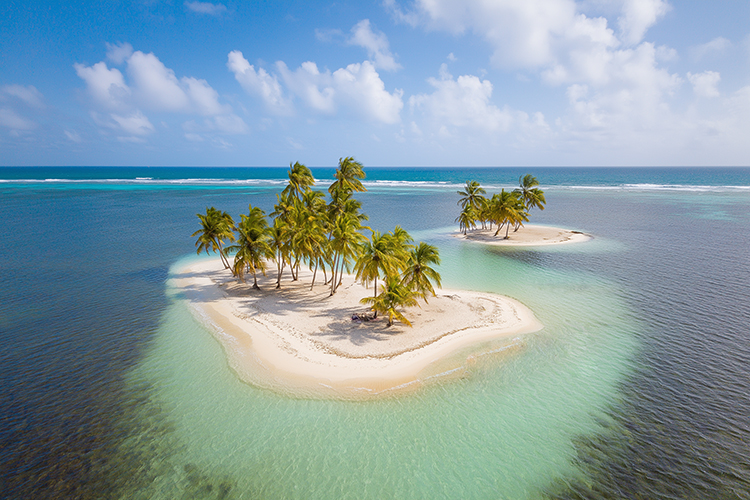
Far from the tourism tracks you can find lonesome islands like in paradise.
Where Paradise Turns into a Party Hell
Another morning in paradise. We’re cruising to Isla Perro. Why? No clue, especially since Captain Raphael kept droning on about how nightmare-level crowded it gets there on weekends.
At 9:00 AM sharp, the armada of day-trippers descended upon Isla Perro, Pelicano, and Diablo like a swarm of locusts hitting a wheat field. If you think „island hopping“ sounds romantic, you’ve clearly never witnessed the morning „boat Tetris“ at the docks. After an hour, the harbor is so jammed that not even a rubber ducky could find a spot to tie up. You have to hand it to the organizers, though: the logistical feat of cramming hundreds of people into an area barely larger than an average parking lot is handled with almost military precision.
The second you step on land, total madness unfolds. While the bars are bursting at the seams, „survival specialists“ plow through the sand with coffin-sized coolers, as if they’re single-handedly supplying a small town with canned beer for a three-week siege. And just to make sure the peace of nature doesn’t stand a chance, people gear up: personal Bluetooth speakers scream over the bar’s PA system—an acoustic war where reggaeton clashes with techno, and your eardrums beg for mercy.
The highlight for the „Look-at-Me“ generation? The „Insta-swing.“ People line up like they’re at airport security just to snap the ultimate proof of their own existence. I was here, therefore I am! It was particularly remarkable to see young ladies with backsides the size of subcompact cars. These anatomical wonders could easily serve as mobile billboards for cellulite cream, but „shame“ is a foreign concept here. The G-string gets adjusted, the chest gets puffed out, and click—the „dream photo from paradise“ is in the bag.
The fact that the background is filled with hundreds of people standing in shallow water, looking more like an overcrowded public pool on the last day of summer in some dreary suburb, is simply filtered out. The sad truth is that paradise moved out of here years ago without leaving a forwarding address. What’s left is an open-air museum of overtourism, where the desperate need for attention has successfully trampled the last bit of idyll to death.
All we could do was snorkel a lap around the overgrown shipwreck—which is actually quite beautiful—before retreating back to our catamaran.
Thick clouds are rolling over paradise now, and the wind is whipping the sea. Our side of the catamaran has run out of water, breakfast is beyond meager, and the captain has gone silent. It’s time for us to say goodbye. The motorboat races over the waves, leaving barely a stitch of our clothing dry. After 45 minutes, we reach the port and have to swap our soaked clothes for dry ones at the car. Then, we hit that 25-mile roller coaster of a road. Every now and then, you see cars pulled over with passengers involuntarily emptying their stomach contents into the bushes. We make it without a „puke stop“—after our „starvation cruise,“ our bodies are trained to hold onto everything at all costs.
The place to be in Casco Viejo is „Casa Casco“ at Plaza Herrera. This restored colonial building with stunning interior design houses three different restaurants, a club, and one of the best rooftop bars. We wanted to grab lunch there, but apparently, Panamanians suffer from the delusion that „seafood“ is vegetarian. So, we hopped over to Hotel Herrera and learned that chimichangas actually exist—and they’re delicious.
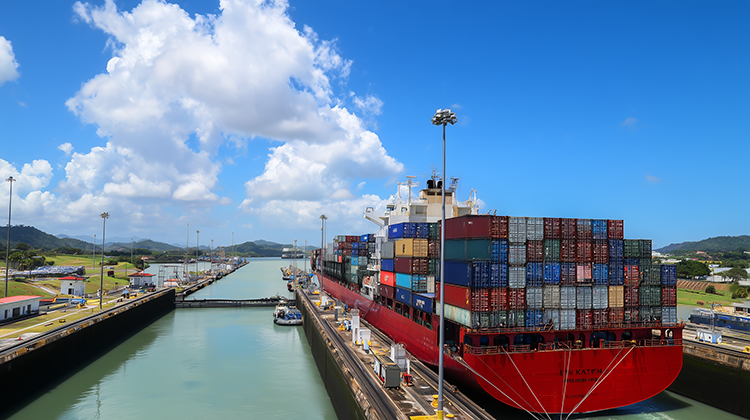 The Panama Canal
Who actually thinks about global shipping in their daily lives? It’s only when a ship like the Ever Given gets stuck sideways in the Suez Canal that we’re suddenly reminded how dependent our lives are on global trade. Nobody stops to consider that six percent of all world trade—and 40 percent of all US container traffic—has to pass through the Panama Canal.
Back in 1914, the opening of the canal was an almost intimate affair. A few gentlemen, likely sporting impressive mustaches and a lot of patience, hauled heavy wooden tripods around and mounted their massive cameras. A glass plate was slid into the back, a quick prayer was sent up to the patron saint of light meters, and then—poof—a magnesium explosion enveloped the scene in toxic smoke. If the smoke cleared and you were lucky, you had a photo. If not, at least you had a new hairstyle and no eyebrows left.
Cut to today. The Panama Canal isn’t just a waterway anymore; it’s a pilgrimage site for people of all stripes.
Upon our arrival, a miracle occurs: we actually find a vacant parking spot right at the Miraflores Visitor Center.
Long lines at the ticket counter. But as the masses stream inside like water into a lock chamber, one thing stands out: nobody is coming back out. The Visitor Center seems to be a black hole for tourists. Where do they all go? Are they being distributed as stowaways on container ships to China at the end of the observation deck?
Everywhere you look, they’re advertising the IMAX movie about the canal narrated by Morgan Freeman. Apparently, that’s all the film has going for it. We want to watch giant ships being locked through, not sit in a theater to see—presumably in 3D—how water gets wet. So, we push through the restaurant. The crowding here is so insane you’d think they were giving away free Kobe steaks or that the captain of the Ever Given was personally signing autographs on napkins.
Finally, the final boss: the stairs to the observation deck. We battle our way through a sea of people and, at one point, seriously consider giving up. Images of structures collapsing under the weight of crowds flash through my mind. I push the thought aside and we keep fighting. We don’t even want this! This level of tourism is unbearable and perverse. But hey, we paid, we’re here, and we just keep going like the rest of the brain-dead lemmings. Miraculously, we eventually make it to the top.
The Panama Canal: a technical masterpiece that began in 1914 with magnesium flashes and is now captured by millions of smartphones. As long as you get the shot, right? Even if you can barely see the ship for all the people in the way. And honestly, we’re doing the exact same thing—the only difference is I lugged a „real“ camera along.
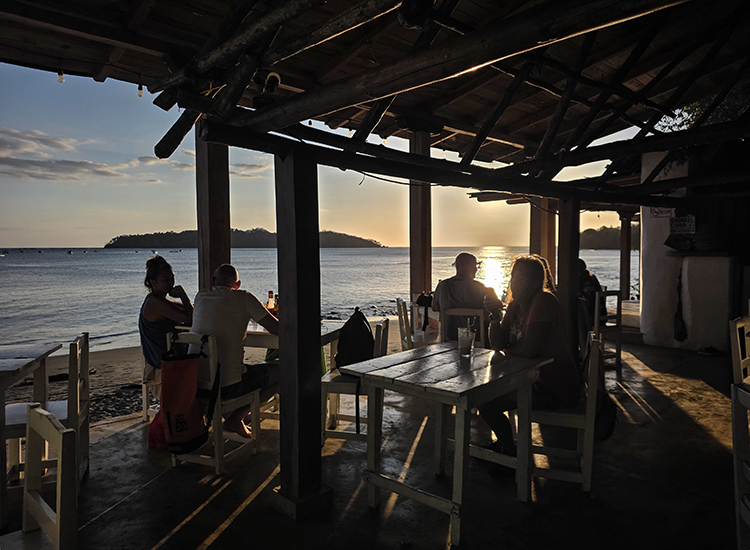
Sunset im Penguine Café am Playa Santa Catalina
Santa Catalina
220 miles (357 km) can feel like an eternity, especially if you actually stick to the speed limit. I didn’t. The cop showed me his radar gun: 78 in a 60 zone (km/h). „70 Balboas,“ he said at first. We pushed back. Pay up or get a ticket? We told him: „Fine, write the ticket.“ Suddenly, the price dropped to 50 dollars (which is one-to-one with the Balboa). We held out a 20-dollar bill, which he grabbed with a massive grin. By the end of the trip, we’d basically bought 45 minutes of our lives back for 20 bucks. The thermometer hit 93°F (34°C) as we rolled into Santa Catalina. This is the gateway to Coiba National Park—out in those depths, hammerheads patrol the blue darkness, humpback whales breach with primal force, and manta rays and whale sharks glide through the deep like silent shadows.
More than anything, Santa Catalina is a surf spot. The vibe is all young people in flip-flops or going barefoot. Along the two nameless streets, you’ll find hostels, dive shops, and makeshift surfer-style eateries. You can still feel that old-school backpacker spirit here—a hint of an era when traveling was an actual discovery, not a mass-produced commodity. Visitors and locals feel like one tight-knit community. We soaked in that raw sense of freedom while the sky over the Pacific set itself on fire in an almost sinfully cliché shade of purple.
The price for staying in this refuge is the lack of infrastructure. After sunset, we sat on our terrace with no power. I just hoped the beer in the fridge would stay cold for a few more hours, because sleep was out of the question—without AC, it was actually hotter inside our apartment than out.
Santa Catalina – a new day in paradise
We had breakfast overlooking the Pacific and then drifted down Santa Catalina’s narrow main drag. We hung out in cafés, listening to chill music. Every now and then, a local would pass by and glance into the open-air bars where people like us were lounging. It made me wonder: „What do the village people think of us, given they don’t have these opportunities themselves?“ They surely have to struggle just to provide a decent standard of living for their families. (Rural income in Panama ranges from $275 to $700 a month). The thought dissolved in the heat as the sun and warmth numbed us into a gentle state of laziness. We lay under palm trees that seemed to be stroking the deep blue of the sky with their green fingers. Every breeze was a whisper that chased away the heat for a heartbeat. When the sun hit its zenith, we slid into the pool—though the water barely offered any cooling. As the last light turned into liquid gold, ice cubes clinked in our glasses and the first cold Caipirinha hit the back of our throats. When the tart scent of crushed limes and dark cane sugar merges with the fading light, you realize: this is the pulse of paradise. A day purely meant for feeling what life is actually all about.
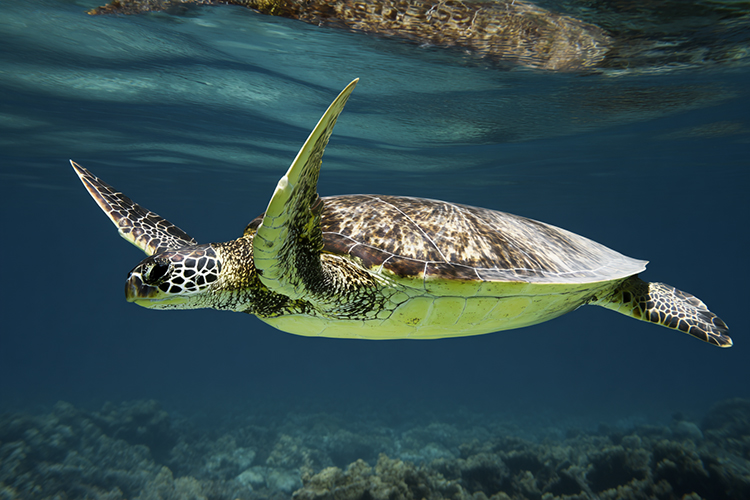 Coiba National Park
I had planned to go diving in Coiba Marine Park and had even booked it. But at the dive shop, we talked to a Dane who had just gotten back. He looked pretty let down. The water was murky with plankton and krill; they barely saw any fish, let alone the mantas or whale sharks that are the big draw alongside the humpbacks. Later that evening, we talked to a couple who went snorkeling and saw dolphins, turtles, sharks, moray eels, a manta, and a devil ray. It became clear: snorkeling here is probably better than diving right now.
So, we booked a tour to Coiba through our hotel, „Time Out.“ It was actually cheaper than GetYourGuide. At 8:00 AM sharp, we were picked up in a state of total Zen. After a quick transfer to the base, it was „find the right fins“ time. Then came another lesson in Panamanian chill. While Europeans tend to check their watches nervously, we just waited until every single person had sorted through their gear, sunscreen, and miscellaneous junk at a cozy „Panama pace.“
By 9:00 AM, the engines roared to life, and we spent an hour racing across the North Pacific. Along the way, we spotted some adventurous rays that seemed to be asking, „Why do we only live underwater? Let’s see what’s up top.“ They leaped out of the water, only for gravity to yank them back into their wet reality. We did the opposite and plopped right in! Turtles glided past us majestically, white-tip reef sharks patrolled the depths, and countless colorful sea creatures—names we’d probably have to look up in an encyclopedia—crossed our path. During a stop on one of the islands for some sun and a dip in the shallows, even a rare hawk graced us with its presence, watching us tourists skeptically from the palms. On the way back, we saw dolphins, though they didn’t feel like jumping for a photo. Deep blue clouds had gathered over the mainland, and it looked like it had been pouring in Santa Catalina for hours. Thanks to our trip, we’d stretched out the sunny part of the day. When we finally docked, it really was raining cats and dogs. But you know what? It didn’t matter. Walking down the main street, the downpour felt like one giant, warm shower. In Panama, nobody lets it bother them—people just keep walking in their board shorts or bikinis like nothing’s happening. It was a great day, and our last one in Santa Catalina.
Panamericana – Interamericana
The engine screams again. Once more, our underpowered car tries to conquer one of the mountains. We’ve got 236 miles (380 km) ahead of us today. The road winds up and down. The hillsides have been cleared. We wonder, „What do people even do out here?“ Cattle loading ramps soon reveal the secret. We hit the Pan-American Highway—once the Holy Grail for adventurers wanting to conquer the continent on a road trip. In Panama, it’s humble, almost incognito—no signs, no pomp, just bare asphalt. We pull over at a gas station for water and soda, and I lose my mind because they have popsicles. Forget gelato—I love a good popsicle straight out of a gas station freezer chest! In this heat, it’s a revelation.
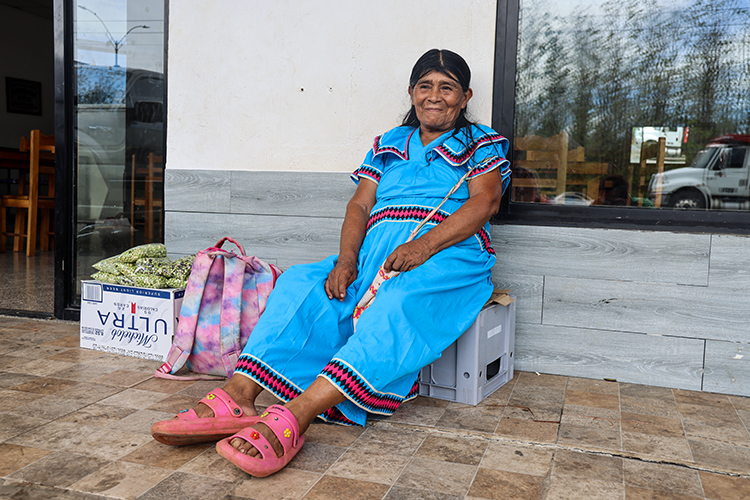
Indigene Frau die an der Carretera Panamericana getrocknete Erbsen verkauft.
A woman and her daughter, maybe five years old, are selling dried peas outside the station restaurant. For a few Balboas, we get permission to take a photo and buy the girl a mango squeeze pouch. Call it a handout, call it easing our conscience—in moments like these, I just have that impulse. We can’t save the world; we can’t send this girl to school. But it’s not just the photo that will keep her in our memories. No matter where we travel, we can never ignore how drastically our realities differ.
We hang a right and start climbing the Cordillera Central. The car struggles. The drive drags on. To the left and right, women sit in the villages offering bananas, beans, peas, pineapples, papayas, and mangoes. The villages get smaller, the huts simpler—just a few beams, boards, and palm fronds for a roof. Chickens and dogs wander the sandy yards. After six hours of driving, the curtain finally pulls back. The blue of the ocean flashes on the horizon. Almirante lies ahead—the grimy gateway to an island world just waiting to be explored.
Bocas del Toro is where the emerald rainforest kisses the turquoise sea—a vibrant mosaic of enchanted mangrove labyrinths pulsing with the tides and golden, powdery beaches. In the jungle canopy, sloths climb in slow motion, while at Starfish Beach, glowing starfish rest in the shallows like sunken constellations. The scent of salt spray mixes with the heavy aroma of tropical blooms, while the distant call of howler monkeys provides the soundtrack to a coastline that shifts from wild and untamed to colorful and bursting with life.
As usual, we roll into Almirante way over the speed limit. Police checkpoint? I hesitate for a second but then hit the gas. Google Maps is overwhelmed trying to find the boat and ferry docks. However, the hustlers and scammers lurking for tourists find us instantly as we circle around. We quickly realize that the „roadblock“ at the edge of town wasn’t official at all. Even in town, people try to force their overpriced services on us. One guy on a bike keeps chasing us, but finally, we reach our destination—to his disappointment—and pull into the yard at Gia’s Garage & Home. The gate swings shut behind us.
Gia might be the nicest person in Almirante! We didn’t have a reservation and the lot was full, but she took us in anyway and organized everything. We found out that no more ferries were heading to Colón today, despite what the internet said. Oh well, the ferry wouldn’t have been my first choice anyway. Gia called us a cab and gave us idiot-proof directions on how to get to Isla Bastimentos. On the water taxi, we scored great seats right in front of the engine, sitting on the gas tank. Here we go. The plastic tub was packed with 20 people and hammered across the waves. The jolts rattled us to the bone, and I just marveled—no, I hoped—that the fiberglass structure could handle the dynamic stress. At Isla Colón, we switched boats and headed for Isla Bastimentos, the island that’s supposed to be quiet, natural, and full of literal „lazybones“ (sloths).
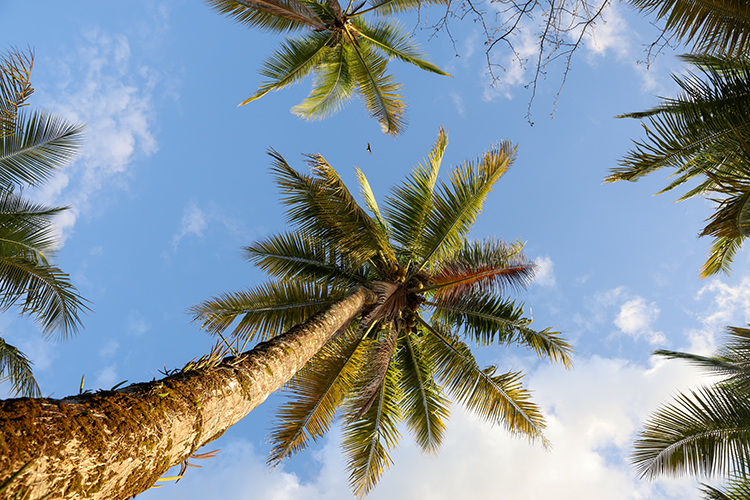 Caribbean Gray
The Palmar Beach Lodge, sitting right on the Caribbean coast, is a masterpiece of hospitality. How they manage to keep this place looking brand new while it’s constantly blasted by salt spray and rain is almost beyond me—it deserves some serious credit. This morning, I headed into the woods to do some wildlife spotting. But all I ran into was a lone raccoon, probably scavenging for the leftovers of some overpriced organic smoothie. That was it. Otherwise, the undergrowth was so quiet it would make a graveyard shift look lively.
Instead of untouched nature, however, I stumbled upon a far more fascinating ecosystem: an opulent housing development for people whose biggest problem is having too many stacks of Benjamins. Who needs useless ecosystems when you can reside in a 4,000-square-foot air-conditioned fortress? Naturally, a pool in the backyard is essential—especially in the Caribbean, where the ocean is apparently just there for decoration.
Judging by the „Se Vende“ (For Sale) signs and the three sweaty joggers I passed, I’d guess the demand for this kind of exclusive isolation is pretty limited.
Since yesterday, the sky has settled on a subtle, permanent shade of gray. The forecast for our final days in Panama is calling for a weather front as stubborn as an uninvited houseguest. But hey, never say die! We discovered today that you can actually swim in the Caribbean even when the red flag is flying and it’s pouring rain.
We even found a sign of life in the pathetic remains of what’s still technically called a „forest.“ We actually spotted nine Strawberry Poison Frogs (Red Frogs). Tiny, red, and gloriously unimpressed by real estate prices or storm fronts. Now, the rain is drumming on the roof, and we’re being forced to relax until the darkness finally swallows the day.
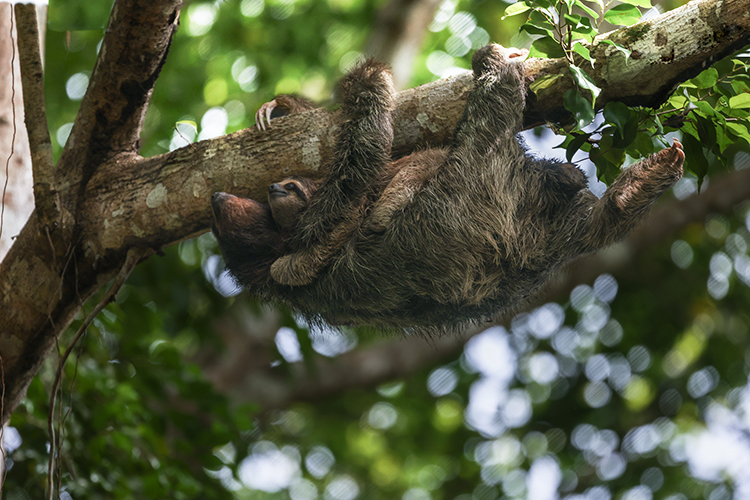
Dreifingerfaultier mit jungem Faulpelz.
The Art of the Find
In the humid, sticky coastal forests of Isla Bastimentos lives arguably the most chill creature on earth. If you want to spot a sloth in the dense canopy of a Cecropia tree—their absolute favorite snack bar—you need nerves of steel. You’ll spend minutes staring intensely at a brown clump thirty feet up, your shirt already soaked with sweat and your finger on the shutter, only to realize with a sigh: it’s just another abandoned termite nest. Since yesterday’s non-stop rain made searching impossible, today was our last shot.
As we scrambled through the undergrowth, we kept tripping over vibrant Red Frogs, which are so thick in the leaf litter it looks like someone spilled a bag of Skittles over the island. But our actual target remained invisible. Patience and persistence are the brutal ground rules of wildlife photography, but hope was fading fast. We eventually gave up and headed toward the boat dock. And right there, where the wilderness meets civilization, it happened: a shadow moved. Directly above us in the branches, we finally found them—an entire family. The highlight? A tiny baby clinging to its mother’s shaggy fur for dear life. The lesson of Bastimentos once again: you can trek through the jungle all day with zero luck, only to find the wildlife living right next door to the humans.
The day ended with a bioluminescence boat tour. It’s this magical phenomenon where marine plankton (dinoflagellates) create a glow in the water whenever they move. I’d never seen anything like it. On the way back, I even managed to snag a small caiman that was being a bit careless. It immediately started crying out for its mother. Figuring I’d rather not be there when Mama Caiman showed up and misinterpreted my „dinner invitation,“ I let the startled little guy go.
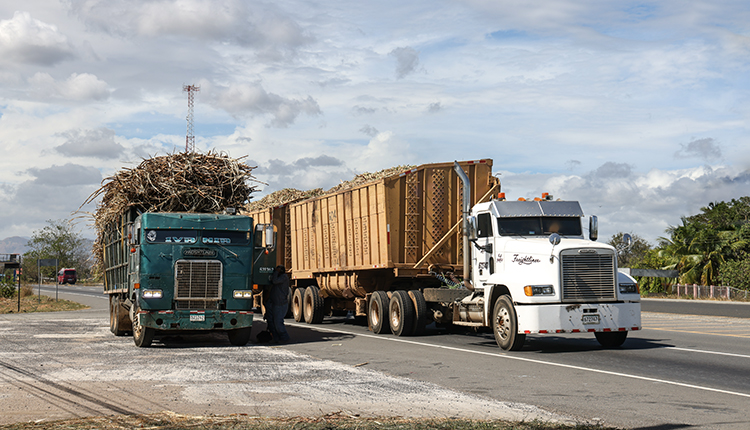
A 1979 Freightliner FLT with a riveted aluminum cab is being overtaken by a 1984 Freightliner FLC120. Both trucks are operated by Central Azucarero de Alanje S.A.
370 Miles
We paid the price for that cheap rental car today. While you can easily fly from Isla Colón back to Panama City in an hour, we had to drive the rental 365 miles (585 km) back to its home base.
Our driving style was probably worthy of a hill climb race. We hauled ass up and down the Cordillera, tires screaming in the corners. We pulled some gutsy moves overtaking buses, trucks, and anyone else crawling along the mountain passes. Thanks to a top-tier co-pilot, I even managed to crush a steering-wheel-burrito on the fly. Unfortunately, a cop caught us with his laser gun, leading to the exact same „negotiation“ as the trip out: down from $75 to $20. I’d love to understand the actual system for „fines“ here, but honestly, I find this approach way more likable than the German one. Either way, there’s a cop monitoring traffic in almost every other town. The sheer police presence on the roads is remarkable and keeps any aggressive driver on high alert. Eventually, we left the cool highlands and cloud forests of Boquete—Panama’s „pantry“ and the birthplace of the famous Geisha coffee. In Chiriquí, we merged onto the gray asphalt of the Pan-American Highway. We still had about 280 miles to go, with the potholes and grooves in the road providing the rhythm for our road trip soundtrack.
But the illusion of speed can vanish quickly. A catastrophic accident involving two totaled semis forced us into a detour. Then there are the „Retenes“—police checkpoints where officers lurk in the shade of trees with lasers, stoically watching traffic or just chatting on their phones, forcing everyone to slow down. The closer you get to Panama City, the thicker the traffic gets, until the speedometer sits at zero more often than you’d like. Traffic jams leaving the city, traffic jams entering the city—gridlock everywhere. But eventually, even the longest drive comes to an end.
It was just starting to get dark as we crossed the Centennial Bridge. Now, it’s only two miles to the Holiday Inn Panama Canal, where we can watch the ships go by from our room on the 6th floor.
 Last but Not Least
At 7:38 AM, we were at the entrance to the Miraflores Visitor Center, only to be harshly turned away by a security guard. „We don’t open until 8:00!“ What an absolute joke. We rolled back around at 7:55 AM, trailing a line of cars and buses. Five „Mein Schiff“ cruise buses had already dumped their passengers here, and the parking lot was already filling up fast. We joined the queue, bought our tickets, and managed to snag second-row spots on the way-too-small observation deck. In their infinite wisdom, they decided to leave the roof off the deck. Whether it’s torrential rain or the scorching 93°F (34°C) sun, visitors get the full, „immersive“ experience. Two ships were locked through this morning. The announcer, blaring over the speakers throughout the visit, kept emphasizing that 36 ships pass through daily. What he doesn’t say is that this number includes every tugboat, sailboat, and tour boat. Visitors expect to see massive container ships or tankers, which is actually pretty rare. We got lucky again today with two of those big boys.
What every visitor wants to see: locomotives pulling a ship into the Miraflores Locks.
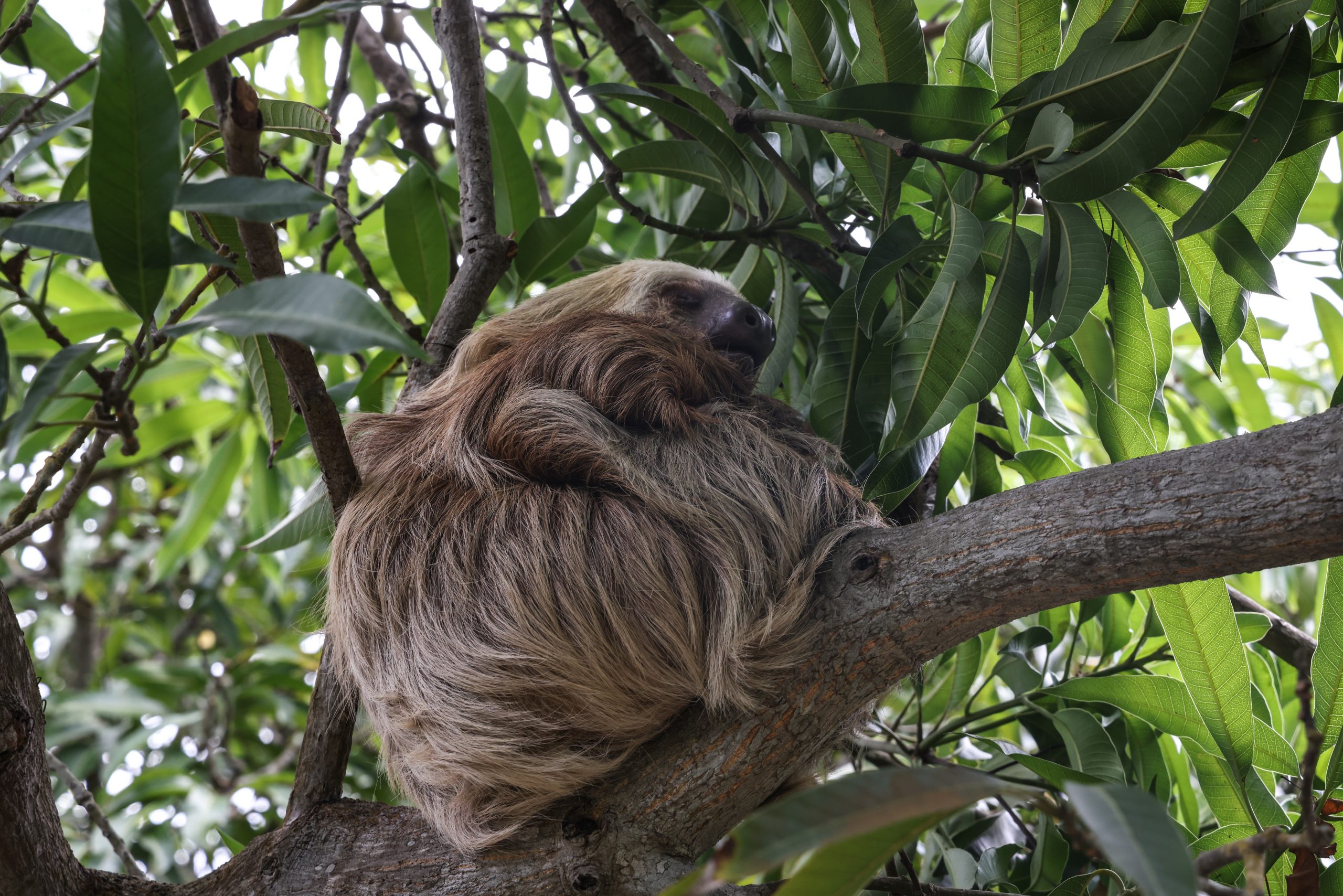
After two hours, we raced over to the Punta Culebra Nature Center on the Amador Causeway and spotted two two-toed sloths, one of which had a baby. They aren’t native to this exact spot but can move between sanctuaries whenever they like. Consequently, the number of two-toed and three-toed sloths on the Amador Peninsula fluctuates between five and twenty-five.
On the edge of the old town sits Café Coca-Cola (Av. Central España). In 1903, the Americans began construction on the canal, and Coca-Cola stepped up to quench the workers‘ thirst, building a bottling plant in 1906. (I wonder if the workers realized by 1907 that Coke actually makes you thirstier?) The growing influence of the brand led the restaurant owners to change the name to Coca-Cola Café. In the 1950s, Coca-Cola sued the café twice over naming rights—and lost both times. The café was visited by the likes of Che Guevara and Fidel Castro in 1953 while they were planning the Cuban Revolution. Other guests included Juan and Evita Perón during their exile, Pablo Neruda, Julio Iglesias, and Gilberto Santa Rosa. Even Pierce Brosnan and Daniel Craig were here while filming on location.
Outside the door, a man approached us: „Don’t carry that camera and smartphone out in the open. It’s too dangerous in this area.“ Casco Viejo is basically a „Disney World“ for tourists. Just one or two streets outside the polished visitor district, you’re faced with bitter poverty and total urban decay. We saw many people scavenging through trash for anything useful. It smells of sewage and decomposition.
And that’s it for our trip to Panama, the world between two oceans. The pristine island paradises and the gleaming skylines of Panama City are a matrix that tourists all too willingly enter—clinging to the illusion of a perfect world that, in reality, doesn’t exist.